

Description
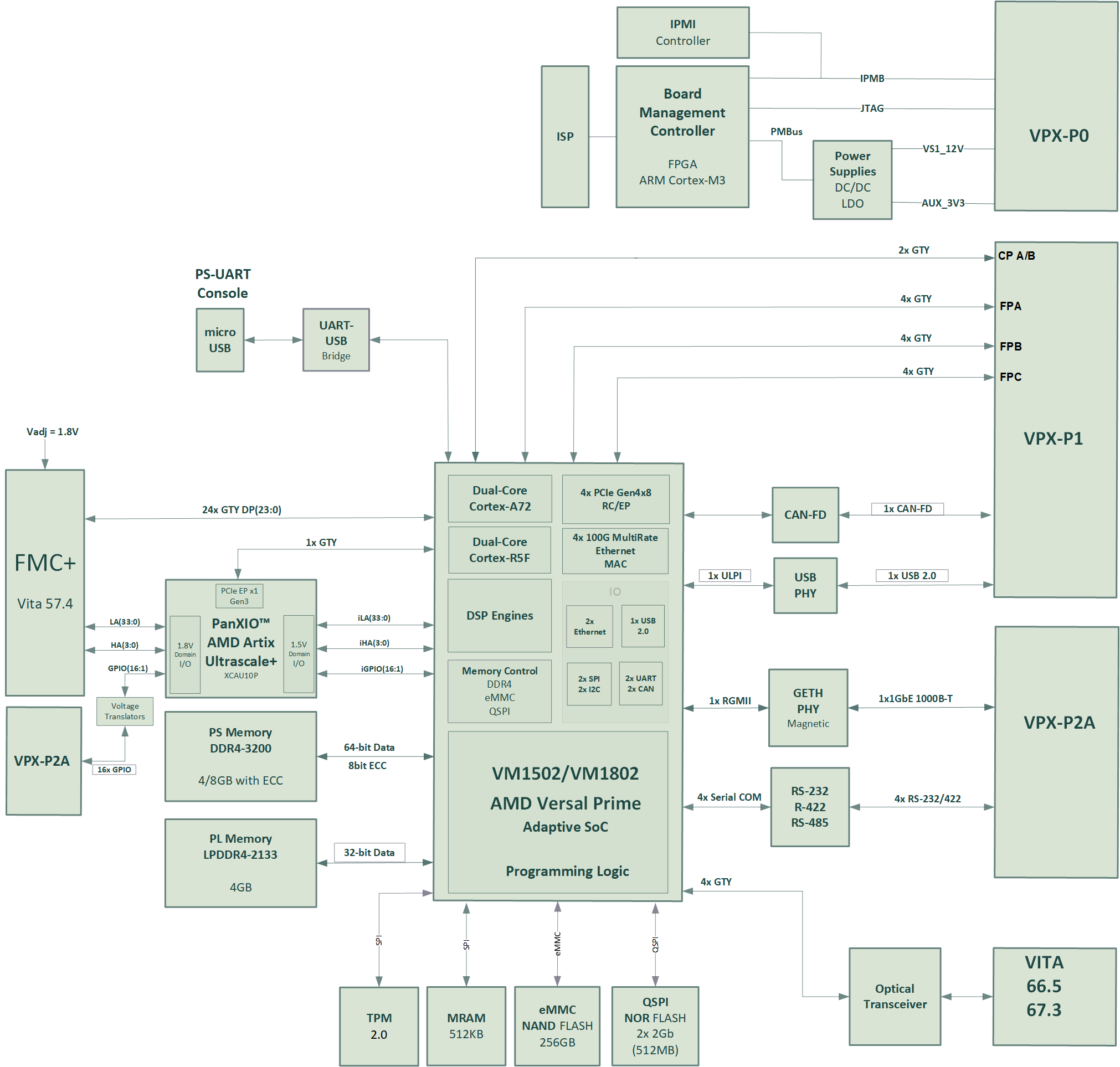
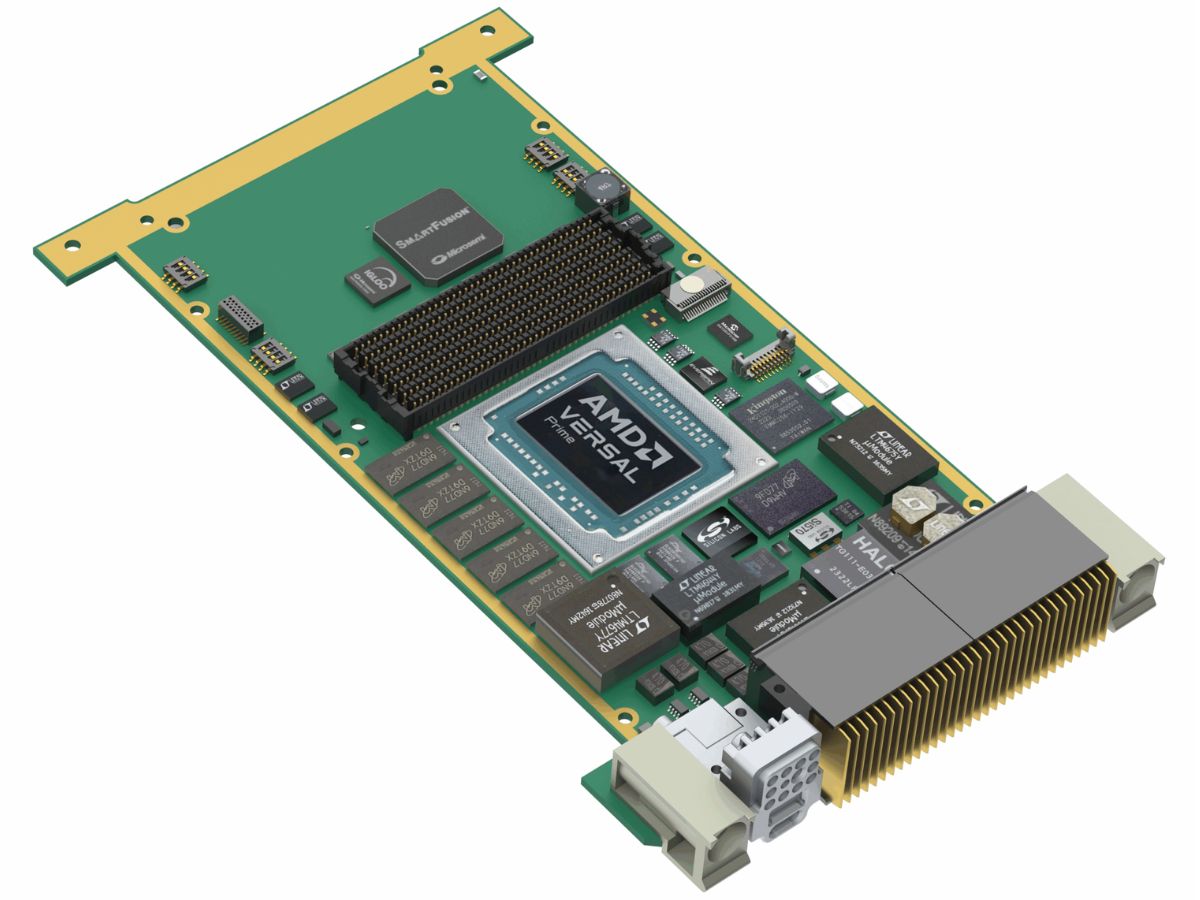
PanaTeQ’s VPX3VPX3-VERSA2 is a 3U OpenVPX module based on the AMD Versal Prime Series adaptive SoC, supporting the VM1502 and VM1802 devices in the VFVC1760 package.
The Versal Prime device integrates a Dual-Core Arm Cortex-A72 Application Processing Unit (APU), a Dual-Core Arm Cortex-R5F Real-Time Processing Unit (RPU), DSP Engines and a large Programmable Logic fabric in a single device. It also provides high-speed serial transceivers, integrated PCIe and Ethernet resources, on-chip memories and a wide range of peripheral interfaces.
The VPX3-VERSA2 can be configured with 4GB or 8GB of 64-bit DDR4 processing System memory with 8 8-bit ECC. An additional 4GB 32 32-bit LPDDR4 LPDDR4-2133 memory is connected to the Programmable Logic, providing high-bandwidth local memory for signal processing, data acquisition and streaming applications.
A 256GB soldered eMMC device provides local non non-volatile mass storage.
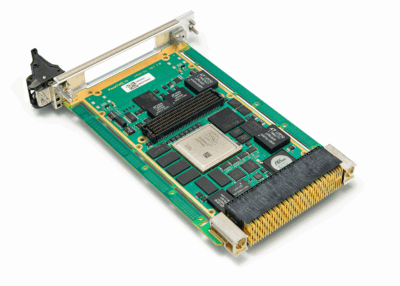
For front-end I/O, an on-board VITA 57.4 FMC+ site provides a flexible interface for a wide range of mezzanine cards used in Electronic Warfare, Software Defined Radio, high-speed communications, RADAR, SONAR, LIDAR, video and signal-processing applications.
The VPX3-VERSA2 introduces PanXIOPanXIO— PanaTeQ eXtensible I/O Architecture, a programmable I/O layer based on an AMD Artix UltraScale+ FPGA. PanXIO provides flexible connectivity and electrical adaptation between the FMC+ parallel I/O, VPX backplane GPIOs and the AMD Versal Prime device.
The FMC+ high-speed serial architecture remains optimised for maximum performance, with 24 GTY transceiver lanes directly connected between the FMC+ site and the Versal Prime device, independently of PanXIO.
The board features advanced digitally controlled power converters with PMBus interfaces together with PanaTeQ’s Smart Power Management architecture and an independent Board Management Controller for power sequencing, monitoring, diagnostics and system management.
The VPX3-VERSA2 can operate as a Single Board Computer and VPX System Controller, eliminating the need for an additional SBC in many systems and proving overall Size, Weight, Power and Cost (SWaP-C).
A large number of peripheral interfaces are available through the VPX backplane, including Gigabit Ethernet, USB 2.0, RS-232/422, GPIOs and CAN-FD.
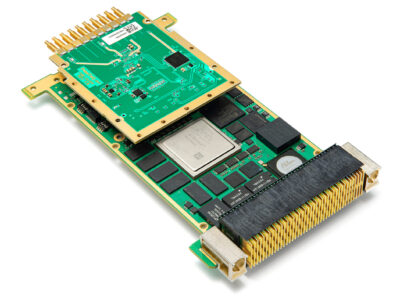
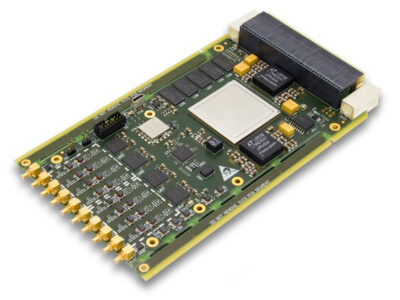
The air-cooled VPX3VPX3-VERSA2VERSA2-PSDK System Development Kit is available for software and FPGA developers and includes the VPX3-VERSA2 module, RTM RTM-VERSA2, laboratory VPX chassis, BSP, FPGA reference designs and required cables.